

Jason Crews is the owner and editor of INFRARED MAGAZINE and a Dallas–Fort Worth-based music journalist and concert photographer. Through INFRARED MAGAZINE and JASON CREWS PHOTOGRAPHY, he covers rock, metal, country, and live music with a focus on album reviews, artist features, concert coverage, and photography. His work is driven by a genuine passion for music and helping artists connect with new audiences through honest writing, strong visuals, and meaningful storytelling.
Rating: 9 / 10 Stars
AVATAR is: Johannes Eckerström (Vocals), Jonas “Kungen” Jarlsby (Guitars and Backing Vocals), Tim Öhrström (Guitars), Henrik Sandelin (Bass), and John Alfredsson (Drums)
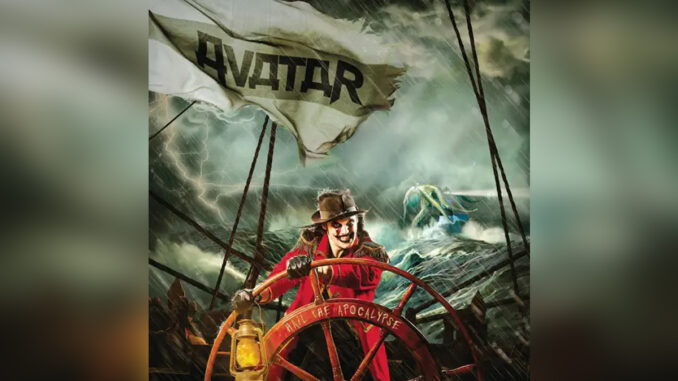
REVIEW – There are records that announce a band’s arrival, and there are records that feel like the moment the doors to the whole damn circus finally swing open. AVATAR have already made clear that they are not interested in becoming another anonymous modern metal export, but with Hail The Apocalypse (Deluxe Edition), set to emerge through Gain Music Entertainment / Entertainment One, the Swedish five-piece seem ready to carve their theatrical identity into something heavier, stranger, and far more dangerous than mere visual gimmickry. Apple Music lists the deluxe edition as a 12-track, 54-minute version of the album, adding “Use And Abuse” as a bonus track to the original sequence.
The title alone feels like a command from the center of a burning city. Hail The Apocalypse does not ask the listener to fear the end. It asks them to salute it. That is Avatar’s great strength in this era: they understand that heavy metal is not only about darkness, but ceremony. It is about making ruin feel grand, decay feel choreographed, and madness feel like an invitation. This is where the band’s carnival grotesquerie starts to become fully inseparable from the music itself.
The opening title track “Hail The Apocalypse” is the kind of song that plants a flag immediately. The riff is blunt, swinging, and enormous, the kind of simple-but-deadly heavy metal architecture that feels designed for bodies to move in unison. Johannes Eckerström sounds less like a frontman than a ringmaster presiding over collapse, letting his voice stalk, snarl, and command. It is theatrical, yes, but not fragile. Underneath the painted grin is a band that knows exactly how to make a groove feel like a blade.
“What I Don’t Know” follows with a darker, more twisting sense of momentum. Avatar are at their best when the songs seem to grin while hiding something rotten behind their teeth, and this track leans into that unease. The band’s blend of melodic death metal bite, groove-metal weight, and strange circus-rock charisma gives the song a restless quality. It feels like a question being asked by someone who may not want the answer.
“Death of Sound” sharpens the record’s industrial and mechanical undertones. The title suggests silence as violence, music as casualty, and noise as the last surviving witness. Avatar have always had a gift for making heaviness feel animated, almost physical, and here the song seems to stomp forward with the confidence of a machine that has learned to sneer. The rhythm section gives it muscle, while the guitars bite with enough precision to keep the theatrical fog from swallowing the impact.
“Vultures Fly” is one of the album’s most immediate and memorable moments, a track that shows Avatar’s growing ability to write hooks without sanding down the menace. The imagery is perfect: scavengers circling overhead, waiting for collapse to become opportunity. That feels central to the record’s apocalyptic mood. This is not just an album about the end. It is about everything that gathers around the end, everything that feeds when systems fail and bodies fall.
Then comes “Bloody Angel,” one of the record’s dramatic centerpieces. At just over six minutes, it gives Avatar room to stretch into something more emotional and cinematic. The title alone contains the band’s entire contradiction: purity and violence, heaven and blood, beauty made grotesque. Eckerström’s performance gives the song its wounded grandeur, while the band allow melody and heaviness to spiral around one another instead of forcing one to dominate. This is where Avatar prove that their theatrical instincts can carry real emotional weight.
“Murderer” brings the blade back down. It is direct, accusatory, and built around the kind of dark energy that makes the band feel both playful and threatening. Avatar’s best heavy songs often work because they do not treat aggression as one-dimensional. There is character in the violence. There is body language. There is a sense that the narrator may be smiling too widely while confessing something terrible.
“Tsar Bomba” explodes by title before the music even begins. Named after the most powerful nuclear weapon ever tested, the song carries the obvious implication of scale, devastation, and human arrogance turned catastrophic. Avatar do not need to overexplain that metaphor. Heavy metal has always understood the absurdity of mankind building bigger and brighter ways to destroy itself. “Tsar Bomba” fits neatly into the album’s world of ruin worship and apocalyptic spectacle.
“Puppet Show” may be one of the most Avatar-like concepts on the record. Control, performance, manipulation, theater, strings, audience—all of it fits the band’s language. Avatar are not merely playing songs; they are staging little nightmares. A puppet show can be childish, comic, sinister, or humiliating depending on who holds the strings. In this album’s atmosphere, it becomes a grotesque miniature of power itself.
“Get In Line” brings a shorter, sharper burst of force into the back half. The phrase sounds authoritarian, but also communal, like a command shouted at the edge of some doomed procession. Avatar’s relationship with order and chaos is one of the album’s most interesting tensions. They sound wild, but the songs are tightly built. They perform madness with discipline. “Get In Line” captures that contradiction: rebellion shaped into a marching rhythm.
The band’s cover of Nirvana’s “Something in the Way” is a fascinating inclusion because it shifts the record’s emotional temperature. The original is skeletal, haunted, and nearly collapsed inward; Avatar’s version has to exist inside a much more theatrical album environment. Rather than feeling like a casual cover, it becomes another shadow in the record’s ruined landscape, a reminder that despair does not always need to scream. Sometimes it just sits under the bridge and waits.
“Tower” closes the original album sequence with one of its most striking emotional statements. The title suggests isolation, height, distance, surveillance, imprisonment, and the lonely arrogance of rising above the world. Avatar have always been good at grandeur, but “Tower” carries a different kind of gravity. It is less carnival and more monument, less grin and more stare. As a closing statement, it feels like the curtain falling not after a joke, but after a warning.
The deluxe edition’s “Use And Abuse” adds one more jagged tooth to the record. As a bonus track, it does not need to redefine the album, but it reinforces the same underlying themes of exploitation, appetite, and power imbalance. The deluxe version’s 12-song track listing places it after “Tower,” making it feel like an encore from the alley behind the theater rather than a clean epilogue.
What makes Hail The Apocalypse (Deluxe Edition) so important in Avatar’s arc is the sense that the band are no longer merely experimenting with identity. They are becoming it. The visual language, the grotesque humor, the theatrical posture, the melodic death metal foundation, the groove-heavy riffing, and the heavy metal showmanship all begin to fuse into one recognizable organism. This is not yet the full empire Avatar will continue building, but it is where the blueprint becomes undeniable.
Johannes Eckerström’s presence is central, but the album works because the whole band commits to the same world. Jonas Jarlsby and Tim Öhrström give the songs their guitar bite and sense of movement, Henrik Sandelin anchors the low end with grim force, and John Alfredsson keeps the whole thing marching, swinging, and lunging forward. Personnel listings for the album identify this five-piece lineup as the core Avatar formation behind Hail The Apocalypse.
The result is a record that feels like a threshold. Avatar are not simply asking listeners to notice them. They are inviting them into a universe where metal can be theatrical without becoming hollow, funny without becoming toothless, and dramatic without losing physical weight. Hail The Apocalypse is both a slogan and a summoning. It is the sound of a band learning how to make the end of the world feel like opening night.
For more information on AVATAR, visit:
www.AvatarMetal.com
www.Facebook.com/AvatarMetal
www.X.com/AvatarMetal
www.Instagram.com/AvatarMetal
www.YouTube.com/@AvatarMetal
www.Spotify.com/Artist/Avatar