

Jason Crews is the owner and editor of INFRARED MAGAZINE and a Dallas–Fort Worth-based music journalist and concert photographer. Through INFRARED MAGAZINE and JASON CREWS PHOTOGRAPHY, he covers rock, metal, country, and live music with a focus on album reviews, artist features, concert coverage, and photography. His work is driven by a genuine passion for music and helping artists connect with new audiences through honest writing, strong visuals, and meaningful storytelling.
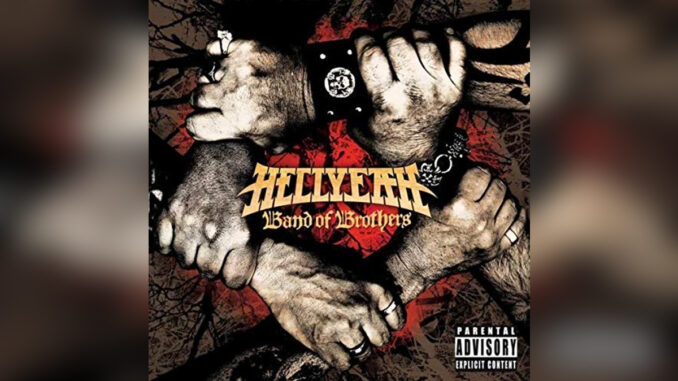
HELLYEAH ‘Band of Brothers’
Rating: 9.5 / 10 Stars
HELLYEAH is: Chad Gray (vocals), Greg Tribbett (guitar), Tom Maxwell (guitar), Bob Zilla (bass), and Vinnie Paul (drums)
REVIEW – For two albums, HELLYEAH seemed determined to prove that five musicians with some of the heaviest résumés in American metal did not need to recreate the bands that made them famous.
On Band of Brothers, they stop worrying about it.
Arriving tomorrow, July 17 through Eleven Seven Music, the third studio album from HELLYEAH is a considerably darker, heavier, and more aggressive record than either 2007’s self-titled debut or 2010’s Stampede. The drinking, Southern attitude, and hell-raising personality have not disappeared completely, but they are no longer running the show.
The metal is.
The biggest change is not simply that the guitars are heavier. Everything feels more confrontational. Chad Gray relies far more heavily on his throat-ripping aggression. Tom Maxwell and Greg Tribbett attack with colder, sharper, deeply down-tuned riffs. Bob Zilla brings enormous weight underneath them, while Vinnie Paul sounds completely liberated behind the kit.
The members are no longer trying to distance themselves from Pantera, Mudvayne, Damageplan, or Nothingface.
They are taking everything those histories taught them and letting it collide.
“War In Me” makes that clear immediately.
Vinnie Paul opens the record with a blistering double-bass attack before the guitars drop into a brutally rhythmic pattern. Gray responds with a clipped, staccato vocal delivery that almost becomes another percussion instrument, every phrase locking against the movement of the riff.
The lyrical conflict is intensely internal. This is not somebody looking for an enemy across the room. It is somebody recognizing that the enemy may already be inside.
That psychological violence gives the music its urgency. There is very little breathing room because the track is built around agitation. The riffs feel restless, the drums refuse to settle, and Gray sounds like he is trying to force something poisonous out of himself.
As an opener, “War In Me” tells you exactly what has changed.
This is not the sound of HELLYEAH cracking open the first beer.
It is the sound of the band throwing the table across the room.
“Band of Brothers” follows by slowing everything into one of the album’s biggest grooves.
The title track is an anthem of loyalty, unity, and the kind of respect forged through shared experience. Vinnie settles into a gigantic mid-tempo pocket while Tribbett and Maxwell build a riff around him that is simple enough to hit immediately but heavy enough to shake a room.
Then comes the chorus.
This thing is designed for a crowd.
The chant-ready structure practically demands thousands of voices shouting it back from the floor, and the song understands exactly how much space to leave around that hook. The guitars add thrash-flavored accents and aggressive wah work without overcomplicating the central groove.
Where “War In Me” is about conflict within one person, “Band of Brothers” is about finding strength in the people standing beside you.
“Rage / Burn” throws that sense of control out the window.
The track moves with frantic energy, constantly shifting between high-speed aggression and crushing half-time weight. Gray sounds absolutely vicious, but the real attraction is the way the band manipulates tempo.
The faster sections create panic.
Then the bridge drops.
Suddenly everything becomes enormous.
That half-time breakdown does not feel like a separate idea pasted onto the song. It feels like all of the anger built during the verses has finally become too heavy to carry at full speed.
Vinnie is devastating throughout. His double-kick work creates the acceleration, but his ability to make the slower section hit even harder proves again that his greatest weapon has never simply been speed.
It is groove.
“Drink Drank Drunk” is the first obvious connection to the older HELLYEAH personality.
Yes, the drinking song survived.
But even the party sounds meaner this time.
There is an underlying swing beneath all of the distortion that keeps the track loose, dirty, and connected to the barroom side of the first two albums. Gray deliberately sounds less controlled here, approaching the vocal like somebody who has crossed the line between having a great night and starting a fight nobody remembers the next morning.
The result bridges both versions of the band effectively.
Old HELLYEAH brought the alcohol.
New HELLYEAH brings the concussion.
“Bigger God” takes the album somewhere much darker.
Bob Zilla becomes particularly important here. His thick bass presence gives the verses an oppressive low-end weight while the song tears into religious hypocrisy, authority, and the use of belief as a mechanism for control.
Rather than exploding immediately, the arrangement builds pressure.
And keeps building it.
The guitars become increasingly dissonant and uncomfortable as the track moves forward. Vinnie maintains the foundation beneath them while Gray grows more confrontational until everything eventually boils over into a crushing breakdown.
“Bigger God” works because it does not merely sound angry.
It sounds disgusted.
“Between You and Nowhere” arrives at exactly the right moment.
After five tracks of confrontation, HELLYEAH finally allow the album to breathe.
The song begins from a cleaner, more acoustic-driven foundation and lets Gray move into one of his least aggressive vocal performances on the record. His clean register exposes an emotional range that could easily have been lost if Band of Brothers committed exclusively to nonstop brutality.
Isolation and longing replace rage.
The chorus expands outward with a melodic Southern-rock character, but it does not feel like the band has suddenly returned to the sound of the previous albums. Instead, the track feels like a necessary emotional counterweight to everything surrounding it.
The restraint makes it heavier in a different way.
And more importantly, it makes the aggression waiting on the other side hit harder.
“Call It Like I See It” restores the hostility immediately.
There is nothing mysterious about what this song wants to say.
Fake people, backstabbers, bullshit, manipulation—Gray is done pretending not to see any of it.
The guitars lock into a bruising syncopated groove with Vinnie’s snare, creating one of the most immediately physical riffs on the record. There is a bounce underneath the heaviness that makes the track move rather than simply crush.
This is one of the places where the rhythmic history of everyone involved becomes particularly obvious.
And that is a good thing.
The groove hits because nobody is trying to hide where it comes from.
“Why Does It Always” keeps the album moving but changes the attack.
Instead of relying on a stop-start groove, the track drives forward with a galloping heavy-metal rhythm and rarely gives the listener much opportunity to catch up.
That momentum perfectly matches the lyrical frustration.
The song deals with self-sabotage and the maddening feeling of repeatedly landing in the same bad situations, asking why everything seems to circle back toward the same problems no matter how hard somebody tries to escape them.
There is something almost exhausting about the way the song keeps pushing.
That works.
The music sounds trapped in the same cycle as the lyrics.
“WM Free” is where defiance takes over again.
This thing sounds dangerous.
Sharp pinched harmonics slice across the riffs while the arrangement maintains a chaotic energy that constantly threatens to come apart. There is still Southern pride running through the track, but it has almost none of the relaxed country-rock atmosphere that appeared elsewhere on the first two records.
This is Southern attitude delivered with clenched teeth.
At just over five minutes, “WM Free” has enough space to become one of the album’s more unruly performances. The band lets the arrangement twist and fight against itself instead of forcing everything into an obvious radio structure.
The instability is the point.
“Dig Myself a Hole” then turns the anger back inward.
Depression, substance abuse, and emotional collapse sit at the center of the track, but what makes it particularly uncomfortable is the awareness behind the title.
Sometimes you know you are making the hole deeper.
Sometimes you keep digging anyway.
The verses remain low and brooding, allowing the tension to sit there before Gray erupts into the choruses. That contrast between restraint and screaming gives the song an almost claustrophobic quality.
Vinnie’s bridge work deserves special attention.
Instead of simply blasting through the transition, he uses syncopated cymbal accents to create instability around the riff. The drums communicate anxiety without having to become faster.
“Dig Myself a Hole” is one of the most personal tracks on Band of Brothers because the enemy is no longer society, religion, fake friends, or anybody else.
The enemy is the person holding the shovel.
“What It Takes to be Me” closes the record exactly where it should.
After everything leading up to it—internal warfare, rage, loyalty, hypocrisy, isolation, betrayal, self-destruction—the final song becomes an uncompromising declaration of identity.
Gray sounds completely unwilling to justify himself.
The message is not that surviving hardship makes somebody perfect.
It is that nobody standing outside those experiences gets to decide what they should have turned into afterward.
Vinnie drives the track forward with the same authority he establishes on “War In Me,” while Zilla keeps the bottom end thick beneath Maxwell and Tribbett.
Then the guitars take over.
The extended dual-guitar conclusion gives the album the ending it deserves: not a fade into reflection, but a final blast of aggression.
No apology.
No neat resolution.
Just a statement.
And then it is over.
That sequence is a major reason Band of Brothers works as well as it does.
“War In Me” opens the psychological battle.
“Band of Brothers” finds strength in unity.
“Rage / Burn” releases the pressure.
“Drink Drank Drunk” briefly reconnects with the band’s past.
“Bigger God” turns outward toward hypocrisy and control.
“Between You and Nowhere” creates emotional space.
“Call It Like I See It” puts the fists back up.
“Why Does It Always” captures the frustration of repeating destructive cycles.
“WM Free” embraces defiance.
“Dig Myself a Hole” confronts self-destruction.
And “What It Takes to be Me” ends by claiming ownership of everything that came before it.
Recorded at Vinnie Paul’s VP’s Upstairs Studio in Dallas and produced by HELLYEAH with Jeremy Parker, Band of Brothers sounds polished enough to hit with enormous modern weight without polishing away the hostility.
The drums are huge.
They should be.
Vinnie Paul is not simply another member of the rhythm section on this album. His playing defines how these songs breathe, accelerate, stop, and attack.
Bob Zilla fills the space underneath him with enough presence to keep the bass from disappearing beneath the deeply down-tuned guitars, while Tribbett and Maxwell increasingly favor rhythmic violence over the bluesy Southern coloration that dominated portions of the earlier records.
Gray responds by becoming considerably more aggressive.
There are still melodic performances when the songs need them, particularly “Between You and Nowhere,” but much of Band of Brothers sounds like somebody removed the safety from his voice.
His screams feel harsher.
His rhythmic phrasing feels more confrontational.
His quieter moments carry more tension because you know what happens when the restraint disappears.
The biggest accomplishment is that none of this feels like HELLYEAH simply deciding to “go heavy” because that is what listeners expect from the musicians involved.
It feels natural.
The first two albums established a personality built around brotherhood, Southern swagger, drinking, hard rock, and groove.
Band of Brothers does not completely abandon that identity.
It weaponizes it.
The alcohol remains on “Drink Drank Drunk.”
The Southern attitude remains inside “WM Free.”
The melodic instincts survive through “Between You and Nowhere.”
But those elements now exist inside a much more aggressive framework.
For the first time, HELLYEAH sound completely comfortable acknowledging every part of where they came from without allowing any one former band to define where they are going.
That may be the real breakthrough.
Nobody needs Vinnie Paul to pretend he does not know how to create a punishing groove.
Nobody needs Chad Gray to suppress the vicious side of his voice.
Nobody needs Greg Tribbett or Tom Maxwell to make their guitars less aggressive because somebody might recognize pieces of their musical histories.
And Bob Zilla certainly does not need to stay politely underneath any of it.
Those histories are not baggage.
They are weapons.
Band of Brothers finally lets the band use them.
Tomorrow, HELLYEAH stop trying to outrun where they came from.
They turn around, face it, and make it hit even harder.
For more information on HELLYEAH, visit:
www.HellyeahBand.net
www.Facebook.com/HellyeahBand
www.Twitter.com/HellyeahBand
www.YouTube.com/HellyeahBand
www.Instagram.com/HellyeahOfficial