

Jason Crews is the owner and editor of INFRARED MAGAZINE and a Dallas–Fort Worth-based music journalist and concert photographer. Through INFRARED MAGAZINE and JASON CREWS PHOTOGRAPHY, he covers rock, metal, country, and live music with a focus on album reviews, artist features, concert coverage, and photography. His work is driven by a genuine passion for music and helping artists connect with new audiences through honest writing, strong visuals, and meaningful storytelling.
Rating: 9 / 10 Stars
MEGADETH is: Dave Mustaine (Lead Vocals, Lead, Rhythm, and Acoustic Guitars), Teemu Mäntysaari (Lead, Rhythm, and Acoustic Guitars), James LoMenzo (Bass Guitar), and Dirk Verbeuren (Drums)


Paid links. As an Amazon Associate I earn from qualifying purchases.
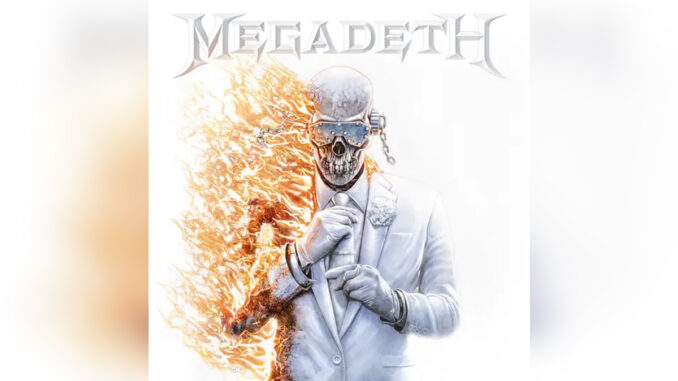
REVIEW – There are farewell albums, and then there are records that sound like a man closing a circle with one hand while still gripping a blade in the other. MEGADETH, the self-titled final album from one of thrash metal’s most enduring and combative institutions, is set to stand as the band’s seventeenth studio full-length and its last statement under the Megadeth banner. The album is slated through Dave Mustaine’s Tradecraft imprint in partnership with Frontiers Label Group’s BLKIIBLK label, with the band’s official track reveal confirming “Tipping Point” and a reimagined bonus version of “Ride the Lightning,” the Metallica classic Mustaine co-wrote with James Hetfield, Cliff Burton, and Lars Ulrich.
That bonus track alone gives the album a mythological weight before the first riff even lands. Megadeth’s history has always been inseparable from exile, resentment, rivalry, ambition, and technical retaliation. Dave Mustaine did not merely respond to being removed from Metallica by forming another band. He built a weapon. From Killing Is My Business… and Business Is Good! onward, Megadeth became one of thrash metal’s most literate, sarcastic, politically agitated, and musically dangerous acts. So for this final album to circle back toward “Ride the Lightning” is not just trivia. It is ritual. It is a reckoning with origin, authorship, and the strange emotional geometry of old wounds.
The opening “Tipping Point” immediately suggests that Mustaine is not entering this final chapter softened by nostalgia. The line “Crossing my heart, how I hope you will die” is pure Mustaine venom: theatrical, vicious, personal, and delivered with the unmistakable sense that some grievances remain useful fuel. As a leadoff track, it does exactly what a final Megadeth album needs to do. It does not bow. It snarls. The song’s title also carries weight in this context. A tipping point is the moment after which return becomes impossible, and Megadeth seem to be stepping directly into that irreversible space with teeth exposed.
“I Don’t Care” follows with punk propulsion and a middle-finger clarity that feels like Mustaine addressing not just an antagonist, but the entire machinery he has fought for decades: industry expectation, public judgment, old enemies, new irritants, and anyone still waiting for him to become diplomatic. The skateboarding-themed video gives the track a scrappy visual identity, but the song itself reads like a refusal to explain. That has always been part of Megadeth’s appeal. Mustaine may analyze, narrate, and dissect, but at his most potent, he simply rejects the premise and accelerates.
“Hey God?!” brings the record into a more existential register. Megadeth have always written songs where politics, religion, war, and personal grievance blur into one another, and this title feels like a question shouted toward a ceiling that may or may not answer. The punctuation matters. It is not reverent. It is not clean disbelief. It is accusation, confusion, and provocation collapsed into one phrase. On a final album, that sort of upward challenge feels appropriate. Mustaine has spent a career arguing with institutions, enemies, governments, systems, and himself. God was never going to escape the cross-examination.
“Let There Be Shred” is one of the album’s most obvious love letters to the thing that made Megadeth immortal: the guitar as weapon, language, sport, and identity. The title is playful, but the implication is serious. Before the politics, before the scandals, before the lineup changes, before the decades of mythology, there was the riff. Mustaine’s right hand remains one of metal’s great engines, and with Teemu Mäntysaari now in the fold, this final era carries a sharpened dual-guitar electricity. Megadeth’s official lineup history lists Mäntysaari alongside Mustaine, James LoMenzo, and Dirk Verbeuren in the current configuration, confirming the band’s present final-album formation.
“Puppet Parade” feels like classic Megadeth satire in title alone. Mustaine has always had a gift for seeing human systems as grotesque theater: politicians as puppets, citizens as spectators, war as choreography, morality as costume. The phrase suggests manipulation not as hidden conspiracy, but as pageantry. Everyone sees the strings and keeps clapping anyway. That kind of cynicism belongs naturally inside Megadeth’s universe, where social critique often arrives with a sneer and a solo sharp enough to draw blood.
“Another Bad Day” turns the focus inward and downward. The title is almost plainspoken by Megadeth standards, but that simplicity gives it force. A bad day can be trivial, but another bad day suggests accumulation. Wear. Fatigue. The grim comedy of endurance. In the context of a farewell album, it becomes more than complaint. It becomes testimony. Megadeth have survived cancer, addiction, firings, lawsuits, feuds, lineup shifts, commercial tides, and the expectations attached to being one of thrash metal’s “Big Four.” Another bad day is just another reason to keep playing.
“Made to Kill” returns the album to more violent terrain, and the title sounds like vintage Megadeth: cold, efficient, almost mechanized. Mustaine’s best aggressive writing often treats violence as both human impulse and institutional design. People are made to kill by war, ideology, resentment, conditioning, and fear. Bands are made to kill by competition and hunger. Songs are made to kill when the riff lands right. The phrase has enough ambiguity to function as threat, diagnosis, and self-description all at once.
“Obey the Call” suggests command language, and Megadeth have long been obsessed with the machinery of obedience. Soldiers obey. Citizens obey. Addicts obey. Believers obey. Musicians obey the call of whatever demon keeps them writing long after comfort would have been easier. On a record framed as the last Megadeth album, the phrase also carries a strange nobility. Mustaine has obeyed this call for more than four decades. It has cost him friendships, health, stability, and peace, but it also built a body of work that rewired heavy metal.
“I Am War” could almost be a final thesis statement. Not “I make war.” Not “I survived war.” I am war. Megadeth’s identity has always been conflict embodied: internal, external, political, musical, spiritual, personal. Mustaine’s voice, even when weathered by time, still carries the scrape of someone who sounds most alive when pushing against something. This track promises the album’s most direct crystallization of that ethos. If Megadeth is ending, it will not end as a peace treaty.
Then comes “The Last Note,” the song that appears most explicitly designed to carry the emotional gravity of goodbye. Originally tied to the grim subject of suicide at the Golden Gate Bridge before shifting toward a more vulnerable farewell, the track’s quoted sentiment—“The roar I lived for, it starts to die / And now it’s time for me to say the long goodbye”—suggests a side of Mustaine that listeners do not always get without armor. Megadeth have built a career on confrontation, but farewells require a different kind of courage. “The Last Note” sounds positioned to give this record its exposed nerve.
And finally, the bonus track “Ride the Lightning” closes the circle in the most loaded way possible. Mustaine revisiting a Metallica song he helped write is not a gimmick so much as a symbolic act. He has done this before in another form with “Mechanix,” his version of material that also evolved into Metallica’s “The Four Horsemen.” But doing “Ride the Lightning” now, at the end of Megadeth’s studio road, feels different. It is not a young man firing back. It is an older artist acknowledging the full shape of the story: the fracture, the rivalry, the resentment, the influence, the shared DNA, and the fact that metal history would look completely different without that original rupture.
Musically, the album’s promise rests heavily on the chemistry of this final lineup. Mustaine remains the unmistakable center, but Teemu Mäntysaari gives the guitar attack a new edge, James LoMenzo brings a veteran low-end presence back into the fold, and Dirk Verbeuren supplies the precise, athletic drumming needed to keep late-career Megadeth from becoming museum thrash. The band’s official site currently points to this lineup and continues to present Megadeth as an active force even as the final-album narrative surrounds the release.
What makes MEGADETH compelling is not the idea that it will reinvent thrash metal. That was never the job of a final Megadeth album. The job is to sound like a band taking inventory of everything that made it dangerous in the first place: speed, spite, technicality, sarcasm, paranoia, guitar worship, apocalyptic imagination, and the unkillable ego required to survive this long in a genre that eats its own.
The record’s farewell quality does not appear sentimental in the traditional sense. Megadeth were never built for soft exits. Even the songs that look backward seem to do so with narrowed eyes. “Let There Be Shred” remembers the fire. “The Last Note” admits the cost. “Ride the Lightning” acknowledges the origin wound. “I Don’t Care” spits at the industry. “Tipping Point” proves the venom still circulates.
If this truly is the final Megadeth album, it seems poised to end the only way Megadeth reasonably could: not with peace, not with apology, not with a polished victory lap, but with riffs, grudges, history, and one last act of controlled combustion. Dave Mustaine may be closing the book, but he is doing it with the pages still smoking.
For more information on MEGADETH, visit:
www.Megadeth.com
www.Facebook.com/Megadeth
www.X.com/Megadeth
www.Instagram.com/Megadeth
www.YouTube.com/@Megadeth
www.Spotify.com/Artist/Megadeth