

Jason Crews is the owner and editor of INFRARED MAGAZINE and a Dallas–Fort Worth-based music journalist and concert photographer. Through INFRARED MAGAZINE and JASON CREWS PHOTOGRAPHY, he covers rock, metal, country, and live music with a focus on album reviews, artist features, concert coverage, and photography. His work is driven by a genuine passion for music and helping artists connect with new audiences through honest writing, strong visuals, and meaningful storytelling.
Rating: 8.5 / 10 Stars
MEGADETH is: Dave Mustaine (Lead Vocals and Guitars), Kiko Loureiro (Guitars), James LoMenzo (Bass), and Dirk Verbeuren (Drums)
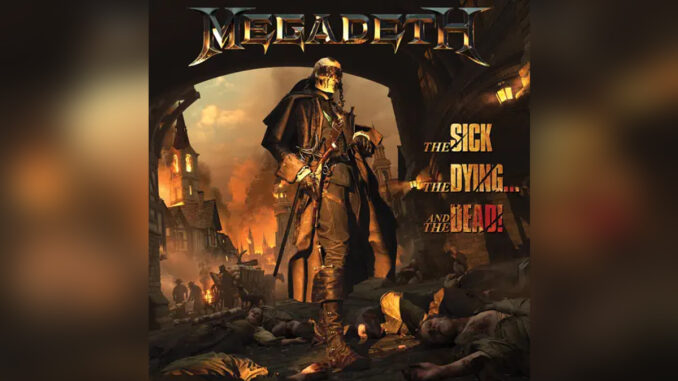
REVIEW – There is a particular electricity that surrounds a new MEGADETH album when the stakes feel personal, professional, and almost mythological at the same time. The Sick, the Dying… and the Dead!, set to arrive September 2, 2022 through Tradecraft / UMe / Universal Music Group, does not simply come after a long wait. It comes after upheaval: lineup changes, survival, public turbulence, and the shadow of Dave Mustaine’s own battles with mortality. Following 2016’s Grammy-winning Dystopia, Megadeth enter this new chapter with a refreshed rhythm section, a vicious sense of focus, and the kind of defiant energy that has always made Mustaine one of thrash metal’s most compelling architects. The album is Megadeth’s sixteenth studio full-length and is set for release via Mustaine’s Tradecraft imprint through Universal/UMe.
The most immediate story surrounding this album is change. Longtime Soilwork drummer Dirk Verbeuren steps fully into the Megadeth machine after joining the band’s touring ranks, while Steve DiGiorgio of Testament handles bass duties on the album recordings following Dave Ellefson’s dismissal. By the time this record reaches the public, James LoMenzo has returned to the band’s live lineup, but DiGiorgio’s presence on the studio sessions gives The Sick, the Dying… and the Dead! a fascinating additional layer. Megadeth have always lived and died by chemistry, precision, and attack, and here that shifting internal architecture seems to sharpen rather than soften the blade.
The title track, “The Sick, the Dying… and the Dead!”, opens the record with a plague-ridden grin. Mustaine has never needed much encouragement to turn historical horror into metal theater, and here he draws from the Black Plague, nursery-rhyme morbidity, disease, rot, and mass death. It is classic Megadeth subject matter because it understands catastrophe as both real and symbolic. The plague is not merely a medieval event. It becomes a mirror for any age that watches sickness spread while people pretend the smell of death can be covered with flowers.
“Life in Hell” follows with the sneering energy of a band that still understands contempt as a musical resource. The title carries a bitter, almost cinematic bite, and Mustaine’s inspiration from the idea of self-absorption gives the song a social and psychological edge. Megadeth have always been strongest when rage has a target, but here the target is not only political or external. It is the human capacity to become so consumed by self-interest that the world burns unnoticed around the edges.
Then comes “Night Stalkers,” featuring Ice-T, one of the album’s most physically imposing pieces. Written about helicopter special operations forces, the track has the velocity and militarized precision of machinery moving under cover of darkness. Ice-T’s presence is not a gimmick; it adds narrative weight and street-level authority to a song already built like a tactical assault. Megadeth have written plenty of war-adjacent material over the decades, but “Night Stalkers” appears to lean into admiration for endurance, discipline, and the kind of danger most people only understand abstractly.
“Dogs of Chernobyl” may be the album’s most devastating conceptual turn. On paper, the image is almost too specific: abandoned dogs left behind in the wake of nuclear catastrophe. But Mustaine transforms that image into a relationship metaphor, a story of abandonment so total it feels radioactive. “You left me like the dogs of Chernobyl” is the kind of line that works because it is grotesque, dramatic, and emotionally direct. Megadeth have always known how to weaponize imagery, and this song seems poised to become one of the album’s most memorable narrative pieces.
“Sacrifice” brings the record into more personal and symbolic territory. Its origin in a memory of jealousy, intimidation, and one musician destroying another’s expensive sunglasses may sound almost absurdly small compared to plague and Chernobyl, but that is part of its charm. Megadeth have never been interested only in global catastrophe. Mustaine is just as capable of turning petty human ugliness into a riff-driven indictment. “Sacrifice” appears to deal in envy, insecurity, and the way threatened egos destroy what they cannot become.
“Junkie” moves into the language of excess, addiction, and bad influence. Mustaine’s history gives this subject obvious weight, but the song’s framing around character traits and destructive circles makes it more than simple autobiography. Megadeth’s best addiction-themed writing has always carried a moral and survivalist edge. It is not preaching from a distance. It is testimony from someone who knows exactly how quickly the wrong people, wrong habits, and wrong appetites can begin dismantling a life.
“Psychopathy” and “Killing Time” form a connected one-two punch, with the former serving as a short, clinical entry point into misdiagnosis, perception, and the way people talk when they think they understand another person’s mind. “Killing Time” expands that idea into something more relational and existential. Mustaine frames it not as murder, but as procrastination, waste, and the terrible realization that time is the only currency no one can earn back. That theme carries added weight coming from an artist who has stared down illness, band turmoil, and decades of public scrutiny. Megadeth’s thrash may be built on speed, but “Killing Time” appears to understand that speed means nothing if you are wasting the heartbeats.
“Soldier On!” feels like the album’s statement of endurance. The title could almost be Megadeth’s career motto. Through firings, addictions, injuries, illnesses, lineup reshuffles, critical battles, and shifting metal climates, Mustaine has remained the immovable center of the storm. The song seems to channel that stubbornness into something less like triumphalism and more like survival doctrine. You do not have to be graceful. You do not have to be universally loved. You just have to keep moving.
“Célebutante” sounds like Megadeth turning its attention toward fame, vanity, and performance. The title itself is a sharp little weapon, fusing celebrity and debutante into something ornamental and hollow. Mustaine’s reference point involving Yngwie Malmsteen gives the song a guitar-world flavor, but the broader implication seems aimed at image, ego, and the strange theater of status. Megadeth have always existed partly as a guitar band for people who care about danger as much as technique, and this track seems to revel in that tension.
“Mission to Mars” promises one of the album’s strangest and most entertaining departures. Mustaine’s fascination with space travel, NASA, scientific absurdity, and humanity’s restless need to launch itself beyond Earth gives the song a classic Megadeth sense of sci-fi cynicism. The band have long understood that the future is only inspiring until humans bring all their old stupidity with them. “Mission to Mars” sounds like a track where wonder and mockery can coexist, with Mustaine staring toward the stars while still muttering about the bill.
Finally, “We’ll Be Back” closes the main album with exactly the kind of declaration Megadeth need in this moment. Released as the first advance single, the track is fast, aggressive, and almost hilariously direct in its message: do not confuse delay, illness, age, or turmoil with surrender. It is one of those late-career songs that functions like a calling card and a warning. The things you can count on, as Mustaine puts it, are death, taxes, and Dave Mustaine coming through hardship. For a band whose legacy has always been sharpened by conflict, “We’ll Be Back” feels less like a promise and more like a threat.
The bonus material adds another layer of personality. Megadeth’s take on Dead Kennedys’ “Police Truck” nods toward punk’s sneer and social disgust, while “This Planet’s On Fire (Burn in Hell)” brings in Sammy Hagar for a cover that fits the album’s apocalyptic mood with almost comic-book precision. These tracks may sit outside the core narrative, but they reinforce the record’s broader sense of fire, decay, authority, absurdity, and refusal.
What makes The Sick, the Dying… and the Dead! so compelling before release is that it appears to be a Megadeth album in the most classic and necessary sense: sharp, technical, sarcastic, historical, paranoid, political, personal, and unwilling to go quietly. Mustaine is not trying to reinvent Megadeth as something unrecognizable. He is reasserting the band’s core language with renewed personnel and sharpened perspective.
Kiko Loureiro’s guitar presence remains crucial, bringing fluidity, taste, and technical brilliance without overwhelming the songs’ identity. Dirk Verbeuren’s drumming gives the material a modern, disciplined violence, while DiGiorgio’s studio bass work promises a muscular foundation from one of metal’s most respected low-end technicians. At the center, of course, is Mustaine: snarling, riffing, narrating collapse, and still sounding like a man who believes every song should come armed.
This is not nostalgia. It is continuity under pressure. Megadeth have always sounded best when the world feels diseased and the band sounds irritated enough to document the symptoms. The Sick, the Dying… and the Dead! is poised to do exactly that, moving from plague ships to Chernobyl, addiction to warfare, wasted time to cosmic ambition, and ending with the only conclusion Megadeth could reasonably offer: they are not finished.
With The Sick, the Dying… and the Dead!, Megadeth seem prepared to deliver a late-career thrash statement with teeth still intact. It is historical horror, personal venom, technical muscle, and survival instinct wrapped in the familiar metallic sneer of one of the genre’s defining bands. The sick may be spreading, the dying may be falling, and the dead may be piling up, but Megadeth sound ready to step over the bodies and keep playing louder.
For more information on MEGADETH, visit:
www.Megadeth.com
www.Facebook.com/Megadeth
www.X.com/Megadeth
www.Instagram.com/Megadeth
www.YouTube.com/@Megadeth
www.Spotify.com/Artist/Megadeth